The Heat & Glo Lanai is a stainless steel outdoor linear gas fireplace that now comes in five models: single-sided in 48, 60, and 72 inch widths, and see-through in 48 and 60 inch widths. It needs no chimney or venting, but it does need a gas line, a GFCI-protected electrical circuit, proper drainage, and the clearances in Heat & Glo's installation manual.
Below is what changed in the line, how the sizes compare, why there is no chimney, and what a Las Vegas installation actually involves, from the gas line to the wind on an open patio.
What Is New in the Heat & Glo Lanai Line?
On November 7, 2026, Kitchen & Bath Business reported that the Lanai Linear Outdoor Gas Fireplace series has been expanded with a new 72 inch single-sided model and a new 60 inch see-through model. That brings the series to five models across 48, 60, and 72 inch sizes.
The same report sums up what makes the Lanai different from a traditional outdoor fireplace:
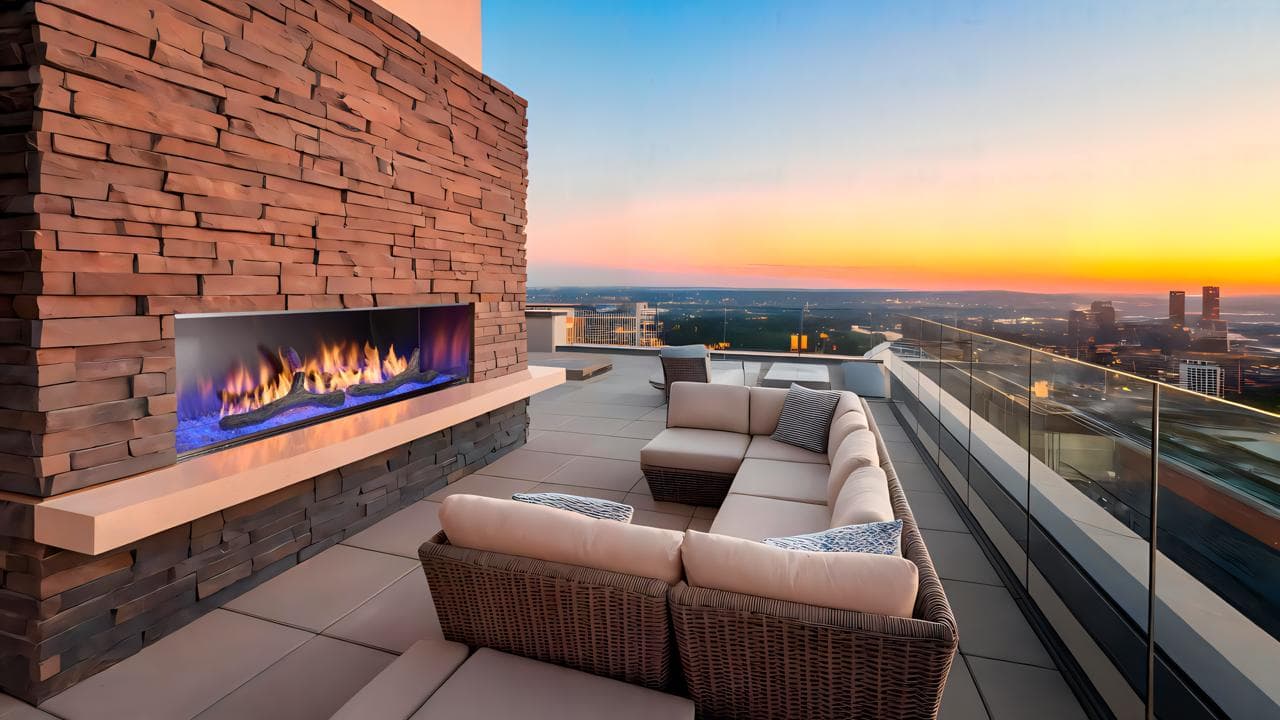
- 304 stainless steel. The firebox is built from rust-resistant 304 stainless steel, with a reflective stainless interior.
- A ribbon flame. An end-to-end linear flame burns over translucent crushed glass.
- No chimney or venting required. That is a big part of why it can go on a patio wall, in an outdoor kitchen, or as a divider between two outdoor spaces.
- A slim footprint. Kitchen & Bath Business cites a 13 inch depth and a 3 inch glass wind guard.
- Options. Log sets, stone kits, and a range of colored glass media.
What Sizes and Configurations Does the Lanai Come In?
Heat & Glo lists the single-sided Lanai in 48, 60, or 72 inch widths and the double-sided, see-through Lanai in 48 or 60 inch widths. The installation manuals list a maximum input rating for each model on natural gas and on propane, and the ratings are the same for both fuels.
| Model | Configuration | Max input (natural gas or propane) | Weight |
|---|---|---|---|
| Lanai 48 | Single-sided | 55,000 BTU/hr | 215 lb |
| Lanai 60 | Single-sided | 65,000 BTU/hr | 245 lb |
| Lanai 72 (new) | Single-sided | 65,000 BTU/hr | 275 lb |
| Lanai 48 see-through | See-through | 55,000 BTU/hr | 210 lb |
| Lanai 60 see-through (new) | See-through | 65,000 BTU/hr | 240 lb |
The 72 inch model has a 72 by 17 inch viewing area, according to the Lanai 72 architect guide. All of the units are 39-1/2 inches tall, so the choice between sizes is really about how wide a flame you want and how much wall you have to work with.
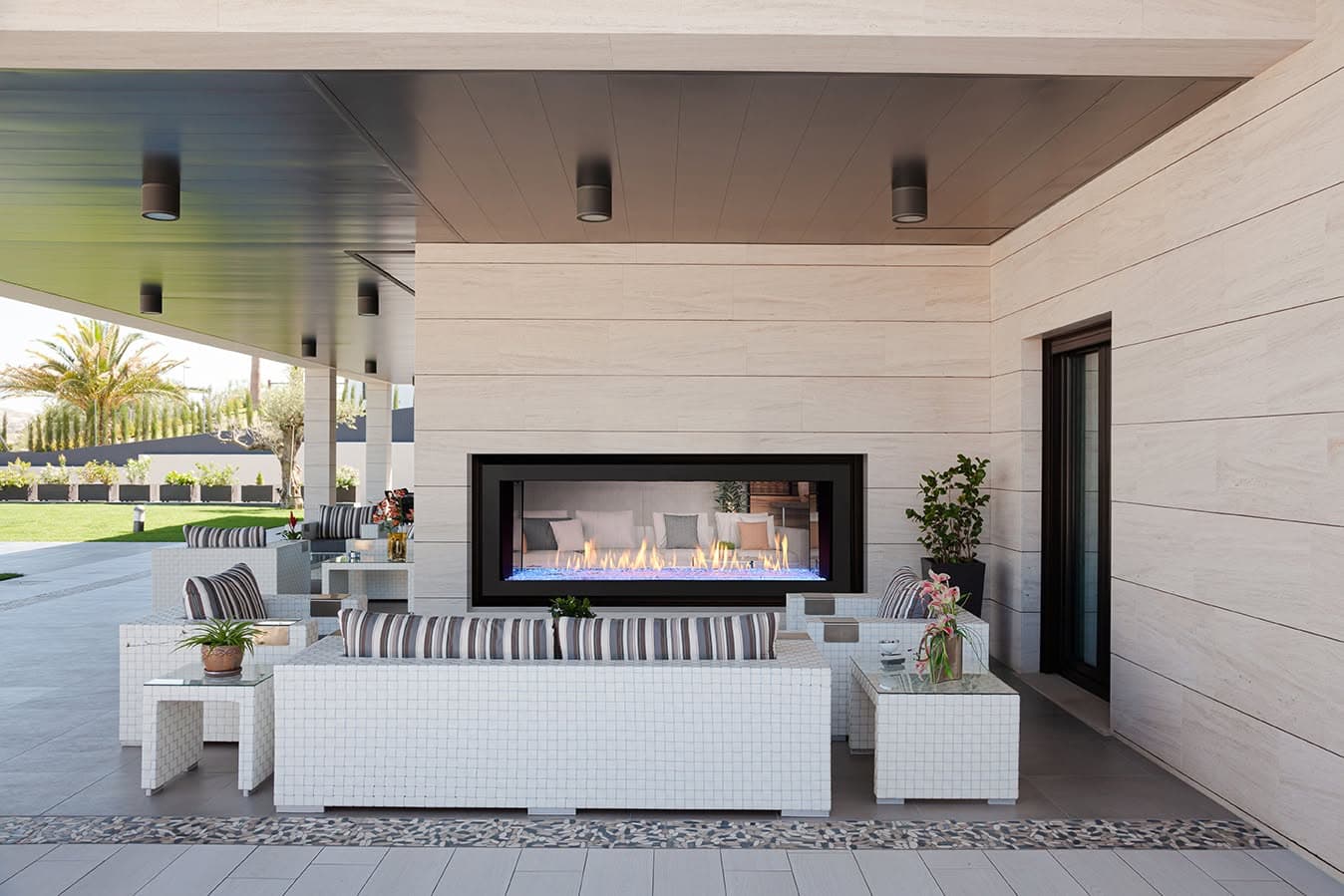
Single-sided or see-through comes down to layout. A single-sided Lanai faces one seating area, usually against a house wall or a built-in feature wall. A see-through Lanai shows the fire on both sides, so it works in a freestanding wall that splits a patio, or between a lounge area and a pool deck. The Lanai uses Heat & Glo's IntelliFire ignition system and a wall control, and Heat & Glo lists multicolor LED lighting that adds color even when the flames are off.
Do Outdoor Gas Fireplaces Need a Chimney?
The Lanai does not. Kitchen & Bath Business reports that no chimney or venting is required. The Lanai installation manual lists the fireplace as an outdoor decorative gas appliance under the ANSI Z21.97 standard, and it carries a plain warning: for outdoor use only.
Because the fire burns in open air, the location does the job a chimney would do indoors. The manual defines an outdoor space as one with shelter no more enclosed than:
- Walls on all sides, but no overhead cover.
- An overhead cover with no more than two side walls, either parallel like a breezeway or at right angles to each other.
- An overhead cover with three side walls, as long as 30 percent or more of the horizontal perimeter is permanently open.
Screen may be used on the open sides, but the manual approves only 14x18 and 16x18 screen mesh and rules out solar screen and no-see-um screen. It also sets minimum distances from the fireplace opening to openable windows and doors (12 inches, or 24 inches with vinyl), to soffits (39 inches), and to a gas meter or regulator (3 feet). That is why where the Lanai goes matters as much as which Lanai you choose.
This answer is specific to the Lanai. Wood-burning outdoor fireplaces and other outdoor gas models have their own venting and clearance rules, so always read the manual for the exact unit you are considering.
What Does It Take to Install a Lanai in Las Vegas?
No chimney does not mean no installation. Heat & Glo says installation must adhere strictly to the instructions shipped with the product, and the manual covers several trades. Here is what a typical Las Vegas Lanai project involves.
A gas line run by a qualified installer
The manual requires gas line installation and purging to be done by a qualified installer or licensed plumber, following local codes or, where there are none, the National Fuel Gas Code (NFPA 54 / ANSI Z223.1) or the International Fuel Gas Code. The manual notes a listed 1/2 inch T-handle manual shut-off valve and a flexible gas connector connected to the control valve inlet. Inlet pressure has to fall within the manual's range for natural gas or propane, which the installer checks with a manometer. If the line will be buried across the yard, USA North 811, which serves Nevada, asks for at least two working days' notice before any digging, and the 811 service is free.
A GFCI-protected electrical circuit
The Lanai needs unswitched 110 to 120 volt power to its junction box for proper operation, and the circuit must be protected by a GFCI breaker. Total draw is under 12 amps. Plan the electrical run along with the gas line so the wall only gets opened once.
Framing, finishes, and drainage
The Lanai can be installed as a standalone unit or built into a wall. It must sit on a continuous flat surface of wood, composite, or non-combustible material that extends the full width and depth of the unit. The manual spells out which framing areas can be combustible and which must be non-combustible, and the face has to be flashed to keep water out of the wall.
Water is part of the design. The manual says the Lanai is built to operate outdoors with rain entering the firebox, and it has drain holes in the base. The builder must give that water a way out of the enclosure, and in some cases a drain pan is needed. Optional drain pans are listed for the 48, 60, and 72 inch widths.
Clearances to the ceiling and to furniture
Under a patio cover, the manual sets a minimum of 39 inches from the top of the firebox opening to the ceiling, and it bars vinyl siding between the opening and the ceiling or overhang. In front, the framing diagrams call for at least 36 inches to any combustible object, and the owner's manual marks a 3 foot clear space in front of the fireplace. Do not install glass doors on the Lanai; the installation manual warns they can overheat adjacent structures.
Permits and inspection
The manual states that installation must comply with local, regional, state, and national codes, and tells you to consult the authority having jurisdiction about installation inspection and permits. In the Las Vegas Valley, that can be Clark County or your city (Las Vegas, Henderson, or North Las Vegas), depending on where you live. Plan on the gas line and electrical work being permitted and inspected, and ask your installer who pulls the permits before work starts.
How Do Las Vegas Wind and Heat Affect an Outdoor Fireplace?
Wind is the condition to plan around. The installation manual warns that the appliance is hot and wind may cause flames to reach out in front, so it says to keep furniture and combustibles away, keep the fireplace out of traffic areas, and clean up fallen leaves and branches before use. The Lanai's built-in glass wind guard helps, and on an open patio, placement helps more. A Lanai set into a wall that shelters it from the prevailing wind will burn more evenly than one standing alone in an open yard.
For upkeep, the Lanai is built from rust-resistant stainless steel for outdoor use. The owner's manual recommends cleaning the stainless with a stainless steel cleaner, an optional screen keeps leaves and debris out when the fireplace is off, and the manual says a qualified service person should inspect the appliance before use and at least once a year. On the outdoor fireplaces we install, we recommend models and add wind guards where appropriate for open patios.
Where Should a Lanai Go on Your Patio?
Before the gas line or framing is planned, walk the space with these questions, which follow the checklist in the installation manual:
- Is the space outdoors by the manual's definition? Count the walls and check the ceiling height above the opening.
- Where are the windows, doors, and air inlets? Openable windows and doors and building air intakes all have minimum distances from the fireplace opening.
- Where is the gas meter? The Lanai cannot go above a meter or regulator within 3 feet horizontally.
- Which way does the wind usually blow? Face the seating out of the prevailing wind where you can.
- Where will water go? Avoid low spots that see running or standing water.
- Where will people walk and sit? Keep the fireplace out of traffic areas, and plan seating outside the clear space.
- Single-sided or see-through? A see-through unit needs a wall with usable space on both sides.
Where Can You Buy a Heat & Glo Outdoor Fireplace in Las Vegas?
Hearth and Home Specialties has been licensed since 2000 and is an authorized Heat & Glo dealer in Las Vegas. We sell and install Heat & Glo outdoor fireplaces, including the Lanai, and coordinate the gas line run, clearances, and framing so the finished fireplace fits your space. Visit our showroom at 3555 W. Quail Ave #A, call (702) 474-4099, or contact us for a free estimate. This guide is general information. Always follow the manufacturer's installation instructions and local codes for your home.
Heat & Glo Lanai FAQs
Do outdoor gas fireplaces need a chimney?
Not the Heat & Glo Lanai. Kitchen & Bath Business reports it needs no chimney or venting. It is listed as an outdoor decorative gas appliance, so it must stay in a space that meets the manual's definition of outdoors.
What sizes does the Heat & Glo Lanai come in?
Five models. Single-sided Lanai units come in 48, 60, and 72 inch widths, and see-through units come in 48 and 60 inch widths. The 72 inch single-sided and 60 inch see-through models are the newest additions.
Can the Lanai run on natural gas or propane?
Yes. The installation manual lists natural gas and propane ratings for every model: 55,000 BTU per hour maximum input for the 48 inch units and 65,000 BTU per hour for the 60 and 72 inch units.
Can I install a Lanai under a covered patio?
Often, yes, within limits. The manual allows an overhead cover with no more than two side walls, or three side walls if at least 30 percent of the perimeter stays permanently open, plus minimum clearances to the ceiling.
How does wind affect an outdoor gas fireplace?
Heat & Glo warns that wind may cause flames to reach out in front of the Lanai, so keep furniture and combustibles away. The Lanai includes a slim glass wind guard, and placement out of the prevailing wind helps.
Where can I buy a Heat & Glo outdoor fireplace in Las Vegas?
Hearth and Home Specialties is an authorized Heat & Glo dealer in Las Vegas. Visit the showroom at 3555 W. Quail Ave #A or call (702) 474-4099 for a free estimate on an outdoor fireplace.
Sources
- Kitchen & Bath Business, Heat & Glo Lanai Linear Outdoor Gas Fireplace (published November 7, 2026)
- Heat & Glo, Lanai Outdoor Gas Fireplace (single-sided, 48, 60 and 72 inch widths)
- Heat & Glo, Lanai Double-Sided Outdoor Gas Fireplace (48 and 60 inch widths)
- Hearth & Home Technologies, Lanai 48/60/72 Installation Manual (4111-901 Rev. J, certification, BTU ratings, outdoor space rules, clearances, gas and electrical)
- Hearth & Home Technologies, Lanai See-Through 48/60 Installation Manual (4113-901 Rev. K)
- Hearth & Home Technologies, Lanai 48/60/72 Owner's Manual (4111-900 Rev. M, clear space, maintenance)
- Hearth & Home Technologies, Lanai 72 Architect Guide (dimensions and framing)
- USA North 811 (call before you dig, Nevada)