A gas fireplace is serviced by a trained gas fireplace technician: a hearth specialist who works on the burner, pilot or ignition, gas valve, glass, logs and venting. In Las Vegas, look for a licensed Nevada contractor that services your brand, ideally with an NFI Gas Specialist on staff. If you smell gas, leave first and call Southwest Gas.
That short answer hides a real question most homeowners run into: the fireplace sits in the living room, but it touches several trades. A gas line feeds it, a vent runs through the wall or roof, and a firebox with its own controls sits in between. This guide explains who does what, what qualifications to check, what a service visit should cover, and when a problem stops being a service call and becomes an emergency.
Who Actually Works on Gas Fireplaces?
Several kinds of professionals can end up near a gas fireplace. Their roles overlap in places, so it helps to know where each one usually fits.
| Who | What they usually handle |
|---|---|
| Gas fireplace technician (hearth specialist) | The appliance itself: pilot and ignition, gas valve, burner, logs or media, glass and gaskets, controls and venting |
| Licensed plumber | Gas piping to the appliance, shutoff valves and connectors; some also service gas appliances |
| Heating and air company | Furnaces and heat pumps; some work on gas fireplaces and some do not |
| Chimney sweep | Masonry chimneys and wood-burning fireplaces; gas units are a different specialty |
| Southwest Gas | Suspected gas leaks and the gas supply, not routine appliance service |
The gas fireplace technician is the person most homeowners need. Gas fireplaces are appliances with their own controls, built to a specific manufacturer's design and installation instructions. Napoleon's owner's manual for its Tall Luxuria Bay series, for example, says installation and service must be performed by a qualified installer, service agency, or the supplier, and tells owners not to attempt to service the electrical or gas components themselves.
Plumbers are the natural fit for the gas line. Southwest Gas, the natural gas utility for the Las Vegas valley, advises on its safety page that licensed plumbers install and repair natural gas equipment and appliances and perform annual inspections and maintenance on gas appliances. Many fireplace jobs involve both trades: a plumber runs or modifies the line, and a hearth technician handles the appliance.
Chimney sweeps are a common first call, but sweeping is mainly wood-burning work. The hearth industry treats gas as its own specialty: the National Fireplace Institute certifies technicians separately for wood-burning, gas and pellet appliances. A sweep who is great with masonry chimneys is not automatically trained on a direct vent gas unit.
Southwest Gas handles emergencies and the gas supply. It does not act as your fireplace repair service. Its safety page directs customers to qualified plumbers, contractors or appliance dealers for appliance service, and it notes that property owners are responsible for maintaining gas lines on their side of the meter.
Why Does the Brand of Your Fireplace Matter?
Gas fireplaces are not generic. Each model has its own valve, ignition system, log or media layout, glass assembly and venting rules, all spelled out in the manufacturer's manual. That is why the first question to ask any technician is whether they work on your brand and model.
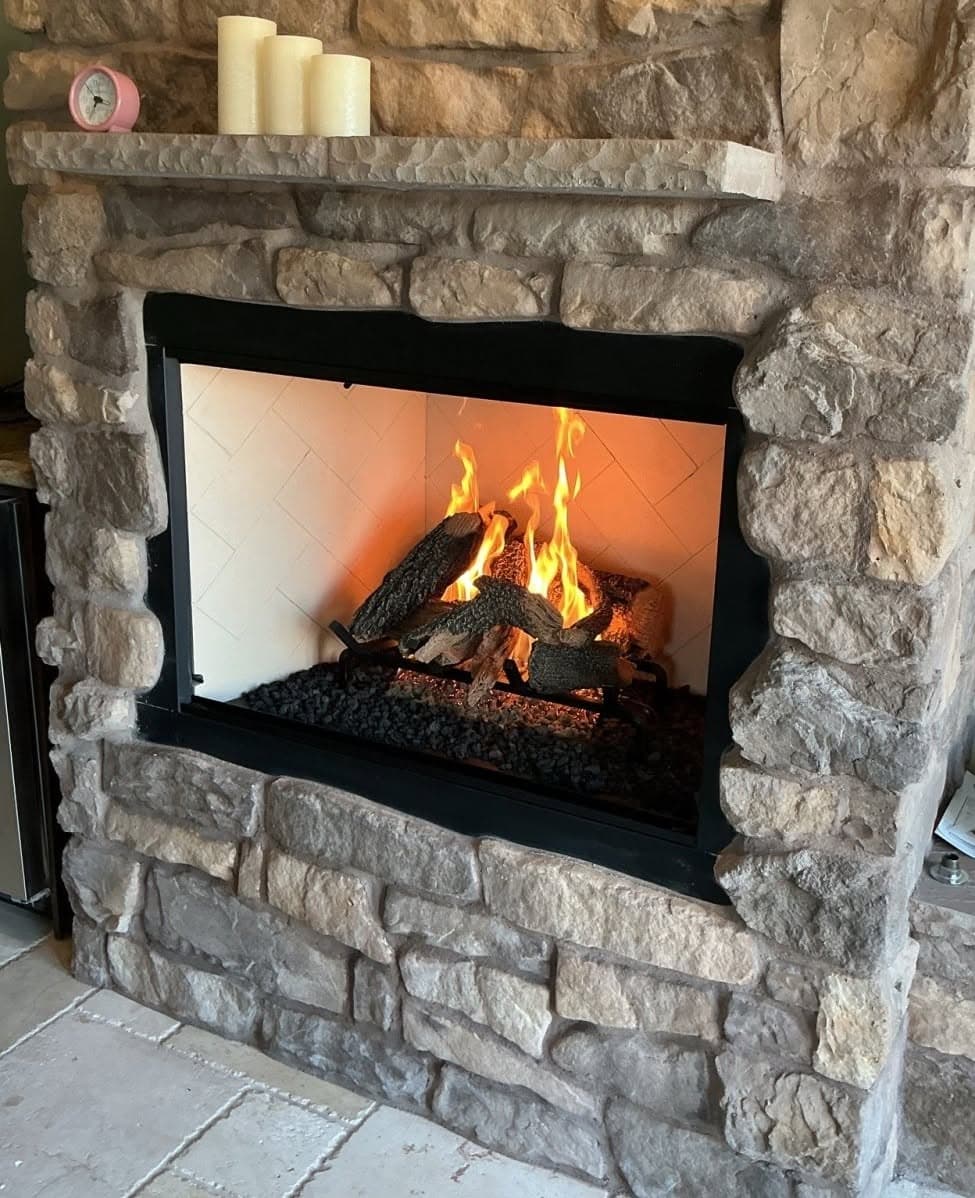
Parts are a good example. Napoleon's manual says replacement glass must be the complete glass and frame assembly supplied by the appliance manufacturer, and it says in capital letters not to substitute materials. The same manual tells owners to contact their authorized dealer with questions about maintenance and service. A technician who carries or can order the manufacturer's parts for your unit can usually finish the job correctly instead of improvising with a part that only looks close.
To find your brand and model, look for the rating plate that is permanently attached to the fireplace. Its location varies by model; on Napoleon's Tall Luxuria Bay series, the manual places it on a chain in the control area near the valve. Your owner's manual shows where yours is. A photo of that plate helps any service company tell you quickly whether they can help, and it is worth having before you call.
What Qualifications Should a Gas Fireplace Technician Have?
A valid Nevada contractor license
In Nevada, contractors are licensed by the Nevada State Contractors Board. The Board's guide to working with contractors says to make sure a contractor is licensed in the correct classification and within the appropriate monetary limit before you sign. You can ask to see the contractor's pocket card, which states the classification, the license number and the monetary limit, and you can look the license up with the Board's online contractor license search.
The stakes are real. The Board says a contract with an unlicensed contractor is null and void by law, and that homeowners who use unlicensed contractors are not eligible for the state's Residential Recovery Fund. If you are not sure whether a license classification fits gas fireplace work, ask the contractor to explain it, or call the Board's Southern Nevada office at (702) 486-1100.
NFI Gas Specialist certification
The National Fireplace Institute (NFI) is an independent, non-profit certification agency, established in 2002, that tests hearth planners and technicians. Its NFI Gas Specialist certification covers gas hearth appliances: log sets, fireplaces, fireplace inserts and freestanding stoves. Candidates have to pass an exam covering topics such as safety and placement, venting requirements and installation guidelines.
NFI is careful about what its credential means. It says certification is not a license or a guarantee of competence, but is an excellent indication of professional commitment and training. Its homeowner page includes a search tool where you can look for certified specialists by specialty and distance. Treat NFI as a strong plus on top of a valid license, not a replacement for one.
Experience with your type of unit
Fireplaces, inserts, log sets, outdoor units and see-through models all behave differently. Ask what the technician works on most often and whether they have serviced your type of unit. A good technician will also tell you plainly when a unit is outside what they service.
What Does a Gas Fireplace Service Visit Cover?
The exact checklist comes from your model's manual, but manufacturers describe the same core idea: the appliance and its venting are both part of the job. Napoleon's owner's manual, for example, says the appliance and its venting system should be inspected before use and at least annually by a qualified service person. It also says:
- Keep it clean inside. Control compartments, burners and circulating air passageways must be kept clean, and more frequent cleaning may be needed because of lint from carpeting and bedding.
- Check the light-up. The burner should ignite completely on all openings, and the manual calls a 5 to 10 second total light-up period satisfactory.
- Keep air moving. The flow of combustion and ventilation air must not be obstructed.
- Glass is a safety part. Do not operate the appliance with the glass door removed, cracked or broken, and glass replacement should be done by a licensed or qualified service person.
- Water damage means parts. If any part of the appliance has been under water, the manual says to call a qualified service technician to inspect it and replace any part of the control system and gas control that was under water.
In practice, a thorough visit typically looks at the pilot or ignition system, burner and flame, logs or media, glass and gaskets, controls and remote, and the vent termination outside. Our guide to post-season fireplace inspection service walks through what a technician checks after a full season of use and the problems that inspection tends to find.
How Often Should a Gas Fireplace Be Serviced?
Once a year is the common answer across sources. Beyond the manufacturer's guidance above, Southwest Gas recommends having natural gas appliances serviced annually by a trained professional, and calls this one of the best ways to prevent carbon monoxide emergencies. The U.S. Consumer Product Safety Commission also advises having heating systems professionally inspected and serviced every year.
Timing is up to you. Spring and summer visits avoid the rush when the first cold nights arrive, which is the case we make in why to service your fireplace in warmer weather. If you are getting ready for winter yourself, our pre-season cold snap checklist covers the homeowner checks that come before a service call.
What Questions Should You Ask Before You Book?
- Do you service my brand and model? Have the rating plate photo ready.
- What is your Nevada license number and classification? Then check it on the NSCB license search.
- Who will do the work, and are they NFI certified? Ask about the technician, not just the company.
- What does the visit include? The answer should cover the appliance and the venting, not only a glass cleaning.
- Can you get the manufacturer's parts for my unit? This matters most for glass, valves and ignition parts.
- Will I get a written estimate before any repair? NSCB advises getting a written contract and not signing anything until you completely understand the terms.
- Will you show me what you found? A good technician explains the problem and the options in plain language.
What Are the Red Flags When Hiring a Gas Fireplace Technician?
- No license number, or reluctance to share it. NSCB says to hire only licensed contractors and to check the license number.
- A large deposit up front. The Board's consumer checklist says a down payment cannot exceed $1,000 or 10% of the contract price, whichever is less, with limited exceptions such as a contractor that has posted a consumer protection bond with the Board.
- Pressure to pay cash. The same checklist says plainly: don't pay cash, and don't let payments get ahead of the work.
- An offer to bypass a safety part. Running a fireplace with cracked glass or a disabled safety control is not a repair.
- Substitute parts on safety components. Manufacturers such as Napoleon say not to substitute materials for glass assemblies.
- A request that you pull the permit. When a permit is needed, NSCB says the contractor should get it before work starts, and that homeowners should not pull it themselves.
When Is a Gas Fireplace Problem an Emergency?
A gas smell is an emergency. Southwest Gas adds an odorant called mercaptan that smells like sulfur or rotten eggs, and it also lists a hissing or roaring sound as a sign of a leak. Its guidance if you suspect a leak:
- Exit the area or building immediately, tell others to leave, and leave the doors open.
- Do not smoke or use matches or lighters, and do not turn any electric switches, thermostats or appliance controls on or off.
- Do not start or stop an engine or use an automatic garage door.
- From a safe place, call 911 and Southwest Gas at 877-860-6020, day or night.
Possible carbon monoxide is an emergency too. Southwest Gas says to leave the premises, get into fresh air and call 911, and not to go back in until an emergency official says it is safe. The CPSC recommends CO alarms on every level of the home and outside sleeping areas.
Cracked glass while the fire is burning calls for care, not panic. Napoleon's manual says not to open the door until the fire is out, and not to run the appliance again until the glass has been replaced.
Most other problems are service calls, not emergencies. If your pilot light keeps going out or your gas fireplace won't turn on, those guides cover the safe homeowner checks and the point where it is time to call a technician.
Gas Fireplace Service in Las Vegas
Hearth & Home Specialties has been licensed since 2000 and is an authorized Heat & Glo dealer in Las Vegas. We provide gas fireplace repair and service across the Las Vegas valley for the brands we sell and carry parts for, including Heat & Glo, Heatilator, Stellar Hearth, Valor, Ortal and Napoleon. If you are not sure what you have, send a photo of the rating plate. Call (702) 474-4099, visit our showroom at 3555 W. Quail Ave #A, or send us the details. This guide is general information. Always follow your fireplace manufacturer's instructions for your specific model.
Gas Fireplace Service FAQs
Who services gas fireplaces?
A trained gas fireplace technician, usually from a hearth specialist or a dealer that sells and services your brand. Plumbers handle gas piping, chimney sweeps focus on wood-burning chimneys, and Southwest Gas responds to suspected leaks.
Can a plumber or HVAC company service my gas fireplace?
Some can. Southwest Gas points customers to licensed plumbers for gas appliance repair and inspection. For the fireplace itself, ask whether the technician works on your brand and model and can get the manufacturer's parts.
What certification should a gas fireplace technician have?
Look for an NFI Gas Specialist, a credential from the National Fireplace Institute that covers gas log sets, fireplaces, inserts and stoves. NFI says certification is not a license, so also confirm the company's Nevada contractor license.
How often should a gas fireplace be serviced?
At least once a year. Napoleon's owner's manual says the appliance and its venting should be inspected before use and at least annually by a qualified service person, and Southwest Gas recommends annual service for natural gas appliances.
How do I check a contractor's license in Nevada?
Use the Nevada State Contractors Board's online license search, or ask to see the contractor's pocket card, which shows the license number, classification and monetary limit. If you have questions about a license, call the Board.
What should I do if I smell gas near my fireplace?
Leave right away, tell others to leave, and leave the doors open. Do not touch switches, thermostats or appliance controls. From a safe place, call 911 and Southwest Gas at 877-860-6020, day or night.
Sources
- Southwest Gas, Safety Information (gas leaks, appliance service, carbon monoxide)
- National Fireplace Institute, Homeowner Resources
- Nevada State Contractors Board, Working With Contractors
- Nevada State Contractors Board, Consumer Checklist
- Nevada State Contractors Board, Contractor License Search
- Napoleon, Tall Luxuria Bay Series Owner's Manual (W415-10008680, B-0, 08.04.2026)
- U.S. Consumer Product Safety Commission, Carbon Monoxide Questions and Answers