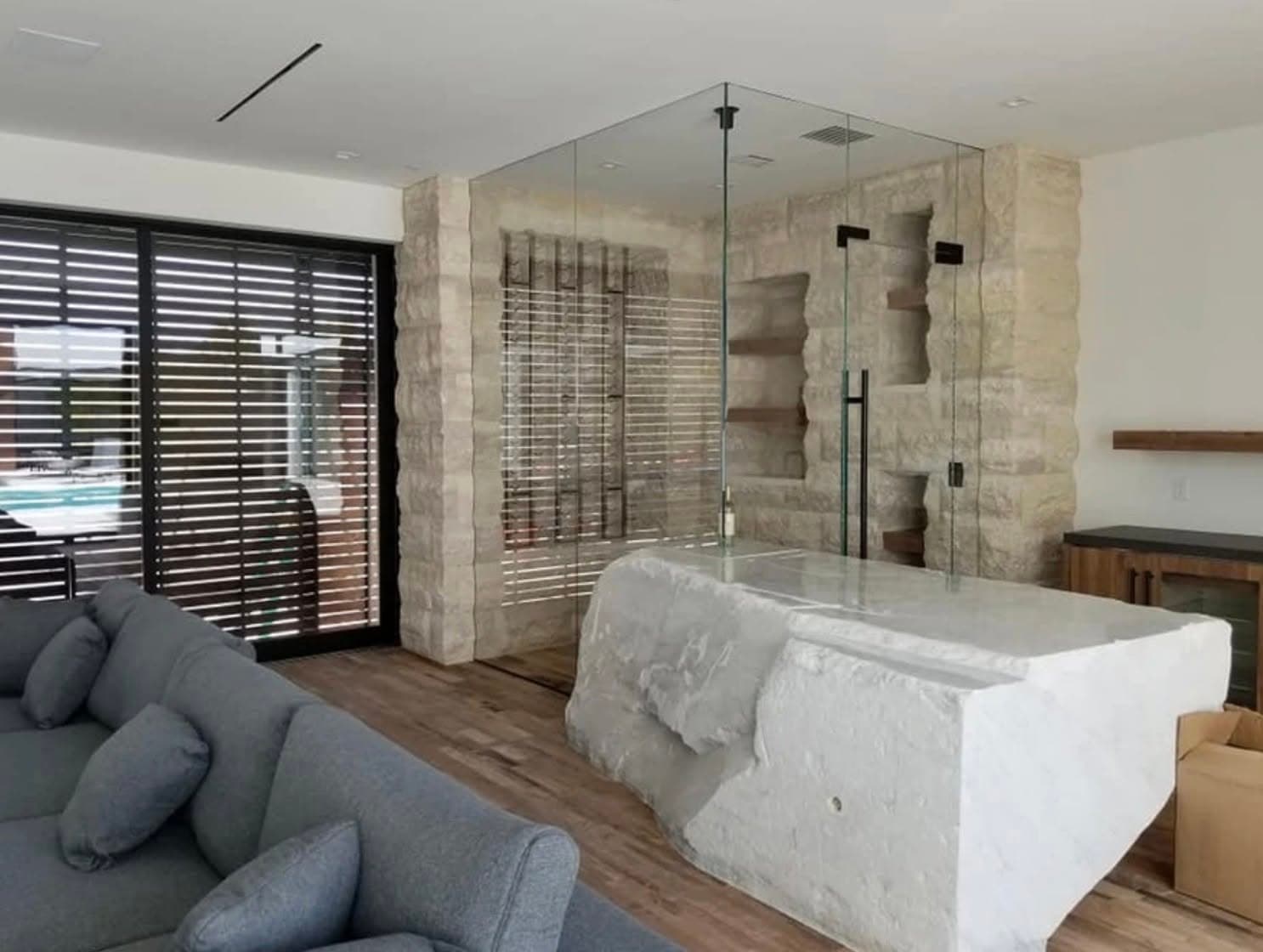
A wine cellar glass wall works by sealing a cooled room behind glass that slows the flow of heat into it. A dedicated cooling unit holds the cellar near 55°F, while insulated safety glass, tight door seals, and a vapor barrier keep warm, humid house air out, so the wine stays steady and the glass stays clear.
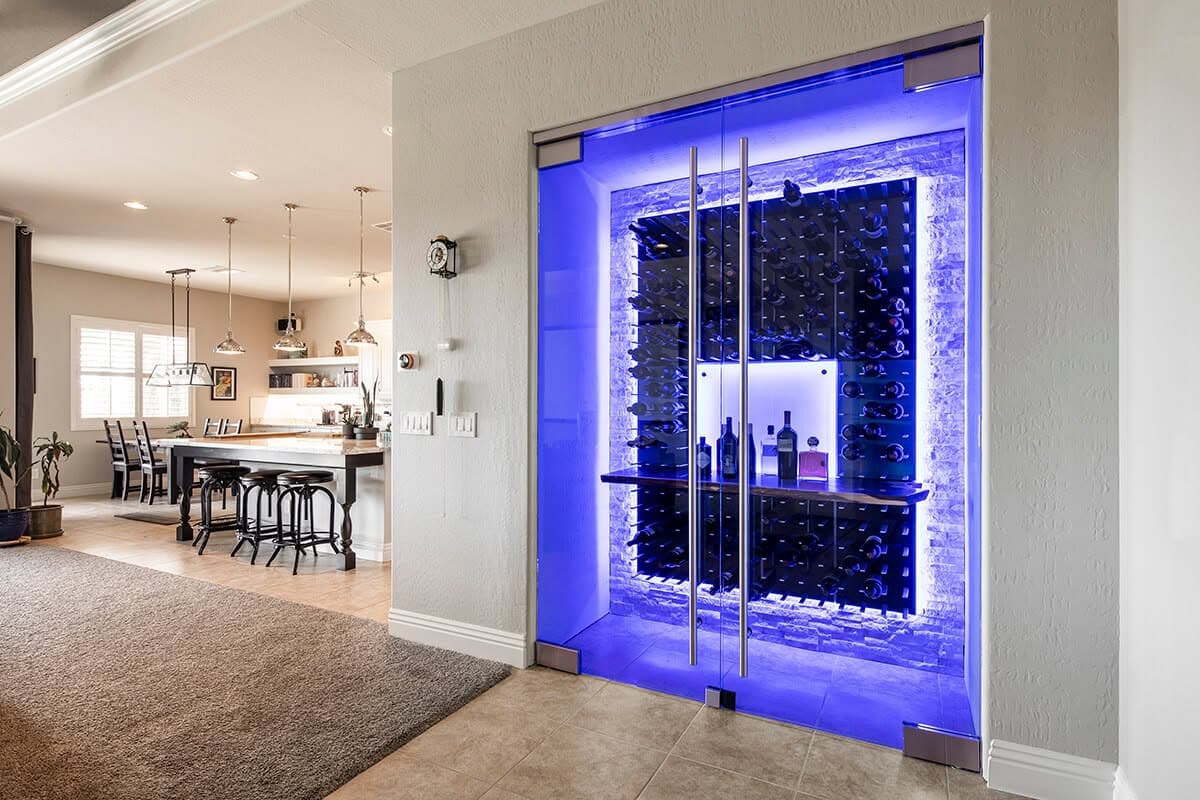
Below is what the cellar side needs, why glass fogs, what door seals and vapor barriers do, how glass changes the cooling load, which glass types fit, and what to decide before ordering. If you are still deciding on a layout, our wine cellar glass page shows the glass walls, frameless doors, and wine walls we install in Las Vegas.
What Temperature and Humidity Does a Wine Cellar Need?
Wine is stored cool and steady. Purdue Extension's Wine Storage Guidelines say wine has traditionally been kept at cellar temperatures of 50 to 60°F, and they describe around 55°F as the traditional cellar temperature for aging. The same guide warns that any temperature above 60°F speeds up maturation, that temperatures above 75°F greatly age most wines, and that temperature swings strain the cork. Its aging estimates assume a constant temperature, within about 2 to 3°F.
Humidity protects the cork. Wine Spectator says anywhere between 50 and 80 percent humidity is considered safe, with ideal humidity around 70 percent. In its wine storage basics, it explains that very dry air could eventually dry out corks and let air into the bottle, while extremely damp conditions can grow mold that damages labels. It also notes that the sun's UV rays can degrade wine, which matters when one side of the room is glass.
| Condition | Target | Source |
|---|---|---|
| Long-term storage temperature | 50 to 60°F, around 55°F traditional | Purdue Extension |
| Temperature stability | Constant, within about 2 to 3°F | Purdue Extension |
| Relative humidity | 50 to 80 percent safe, about 70 percent ideal | Wine Spectator |
| Light | Keep UV and direct sun off the bottles | Wine Spectator |
Those targets are why a glass wine room is a sealed, cooled space and not just a closet with a glass door. Our older post on tips for designing a custom wine cellar covers the rest of the room, from insulation to cool-running LED display lighting.
How Does a Glass Wall Keep the Cold In?
Glass passes heat more easily than an insulated framed wall, so square foot for square foot, the glass usually lets more heat into a wine room than the solid walls around it. The fix is the same one used in energy-efficient windows. The U.S. Department of Energy describes high-performance glass as two or three panes separated by insulating spacers, with a gas such as argon or krypton between them that insulates better than air. Its Guide to Energy-Efficient Windows adds that double or triple panes with argon vastly improve a window's ability to insulate against unwanted heat flow.
On a wine cellar, that means two things. The cooling unit has less heat to remove, so it runs less and holds the temperature more evenly. And the pane facing your living room stays closer to room temperature, which matters for condensation, covered next.
Las Vegas raises the stakes. The National Weather Service lists a normal July high of 104.5°F for Las Vegas, based on 1991 to 2020 normals. A cellar wall that backs onto a garage, an exterior wall, or a sunny window works much harder than one surrounded by air-conditioned rooms. Where you can, put the glass on an interior wall, out of direct sun, facing a conditioned room.
Why Does Wine Cellar Glass Fog Up, and How Do You Stop It?
Fog on a wine cellar wall is condensation, and it comes down to dew point. The National Weather Service defines dew point as the temperature air must be cooled to, at constant pressure, to reach 100 percent relative humidity. Cool air below that point and water vapor has to come out as liquid. The National Fenestration Rating Council puts it simply for windows: condensation occurs when the glass surface is colder than the air around it.
A wine cellar wall is a window turned around. The cold is inside, so the cellar chills the glass, and the warmer air on the room side meets a cool surface. If that surface drops below the dew point of the room air, beads of water form on the outside of the glass. The more humid the room, the higher its dew point, which is why a cellar wall next to a kitchen, a bathroom, or an indoor pool area is more likely to fog than one off a dry living room.
To keep the glass clear:
- Use insulated glass where you can. A sealed unit keeps the room-side pane warmer, and the Department of Energy notes that the spacers between panes help prevent condensation.
- Seal every gap. Air leaking around the door or the glass edges carries room moisture into the cellar and cold air out onto the glass.
- Watch the humidity on both sides. Keep the cellar in its target range and avoid adding moisture to the room outside it.
- Mind the bottles too. Purdue warns that moving bottles from very cold storage into a warmer room can cause condensation on the bottle, label, and cork, which can lead to mold.
What Do Door Seals and Vapor Barriers Do?
The door is the part of a glass wine room that moves, so it is the part most likely to leak. A frameless glass door needs small gaps to swing or slide, and those gaps are where cold air escapes and warm, moist air gets in. That is why we pick the hardware and seals for each wine room door, whether it is a frameless hinged door, a sliding barn-style door, or a pivot door. Seals along the edges and a sweep or threshold at the bottom close the gaps without stopping the door from moving.
The walls and ceiling around the glass need their own moisture control. The Department of Energy explains that a vapor retarder reduces the rate at which water vapor moves through a material, that controlling air-carried moisture takes an air barrier, and that vapor retarders go closest to the warm side of an assembly. In a wine cellar, the warm side is the house side of the walls. Glass itself does not pass water vapor, so the work is at the edges: where the glass meets the framing, floor, and ceiling, the seal should be continuous with the wall's vapor barrier so moisture cannot slip around the glass.
How Is the Cooling Unit Sized for a Glass Wall?
The cooling unit is sized to the heat the cellar gains, not just to the size of the room, and glass is a big part of that heat. Cooling equipment makers publish separate adjustments for glass, based on the square footage of glass, the temperature of the space on the other side, the cellar temperature, and the insulation, and single-pane glass adds much more load than double-pane under the same conditions.
That makes the order of decisions important:
- Settle the glass first. Decide how much glass, which walls, and single or insulated units.
- Hand the numbers to the cooling contractor. Give them the glass area, the glass type, and what is on the warm side of each wall, whether a living room, a garage, or an exterior wall.
- Add the other loads. Lighting, how often the door opens, and the insulation in the solid walls and ceiling all add to the total.
- Size the unit, then build. A unit sized for a solid-walled room will struggle behind a large glass wall.
Which Glass Types Work for a Wine Cellar Wall?
Most wine cellar walls combine a few glass choices. Here is how the main options compare.
| Glass | What it is | Why you would choose it |
|---|---|---|
| Tempered | Heat or chemically treated safety glass | Standard for doors and panels; breaks into small particles |
| Laminated | Two or more pieces of glass bonded to a plastic interlayer | A bonded build; each ply can be tempered |
| Insulated unit | Two or three panes with sealed, gas-filled spaces | Less heat flow and a warmer room-side pane |
| Low-E coated | A coating that reflects heat energy and UV | Helps with heat and sun, especially on brighter walls |
| Low-iron | Glass with less of the green edge tint | Truer color on thick panels and backlit racks |
Tempered glass
Under the federal safety standard for architectural glazing, 16 CFR 1201, tempered glass is specially heat or chemically treated glass that cannot be cut, drilled, ground, or polished after treatment without breaking, and highly tempered glass breaks into small particles. The standard's scope covers glazing used in doors, which is why wine cellar doors use safety glass. Because tempered glass cannot be altered after treatment, every panel, hinge cutout, and handle hole is measured and fabricated before tempering. We use tempered safety glass throughout our wine cellar work.
Laminated glass
The same standard defines laminated glass as two or more pieces of glass, each of which can be tempered, heat strengthened, annealed, or wired, bonded to a resilient plastic interlayer. It is a choice to talk through panel by panel, since it changes the weight, thickness, and fabrication of the glass.
Insulated glass and low-E coatings
Insulated units are the panes-and-spacer assemblies described above, and they do the most for temperature and fog. The Department of Energy's window guide says low-E coatings reflect heat energy and also reflect ultraviolet light, which ties back to Wine Spectator's point that UV rays can degrade wine. A low-E coating is worth asking about on any cellar wall that sees daylight.
Low-iron glass
Standard clear glass has a slight green tint that shows most at the edges and in thicker panels. Low-iron glass reduces that tint, so racks, stone, and LED lighting behind it look closer to their true color. It is a look choice, not a performance one, so ask whether it is available for your project and how it fits the budget.
Framed or frameless
A framed wall holds the glass edges in metal channels, which leaves room for gaskets and for thicker insulated units. A frameless wall uses clips, channels, and hinges at the edges for a nearly invisible look, which is why it shows a collection best. The trade-off is that a slimmer system leaves less room at the edges, so the glass build-up and the seals deserve extra attention. Many wine rooms mix the two, with fixed panels in a slim channel and a frameless door. Our guide to installing interior glass walls covers how fixed glass walls are planned inside a home.
What Should You Decide Before the Glass Is Ordered?
No two glass wine rooms are built the same. These are the choices and site details to settle before the panels are made:
- Size and number of panels. How much of the room is glass, how tall the panels run, and how many corners the layout has.
- Glass type. A single tempered pane, an insulated unit, laminated glass, low-E coatings, and low-iron glass each behave differently on heat, safety, and clarity.
- Framed or frameless. Frameless clips, channels, and hinges, and the finish you choose for them, set the look.
- The door. Hinged, pivot, or sliding barn-style, its size, its hardware, and its seals.
- The cooling side. The glass you choose sets part of the cooling load, so it affects the size of the cooling unit, which is usually a separate trade.
- Site conditions. Whether floors, walls, and ceilings are level and square, how easy it is to get large panels into the room, and whether the wall is new construction or a remodel.
Tempered glass is made to measure and cannot be trimmed on site, so the measurement has to be right before anything is ordered. That is why every project starts with an in-person measure.
Planning a Wine Cellar Glass Wall in Las Vegas
Hearth and Home Specialties has 25+ years of experience with custom glass in Las Vegas, and wine cellar glass is one of our most requested specialty projects. Our team handles the glass portion of the cellar, from enclosure walls to the entry door, as part of our custom glass services. Visit our showroom at 3555 W. Quail Ave #A, call (702) 474-4099, or contact us for a free estimate. This guide is general information. Your cooling contractor sizes the cooling system, and local codes apply to every project.
Wine Cellar Glass Wall FAQs
What temperature should a wine cellar be?
Purdue Extension puts long-term wine storage at 50 to 60°F, with around 55°F as the traditional cellar temperature. Steadiness matters as much as the number, so the cellar should hold within a few degrees all year.
What humidity should a wine cellar have?
Wine Spectator says anywhere from 50 to 80 percent relative humidity is considered safe, with about 70 percent as the ideal. Too dry can dry out corks over time, and too damp can grow mold on labels.
Why does the glass on my wine cellar fog up?
The cellar chills the glass. When the room-side surface drops below the dew point of the air touching it, water condenses on it. Insulated glass, tight seals, and lower humidity in the room around the cellar all help.
Does a wine cellar glass wall need double-pane glass?
It is the better choice for holding the cold. Insulated units with two or three panes slow heat flow, while a single pane lets more heat through, so the cooling unit has to be sized for a larger load.
Does a glass wine cellar door need safety glass?
Yes. The federal safety standard for architectural glazing, 16 CFR 1201, covers glazing used in doors. Tempered glass is the common choice, and it has to be cut and drilled to size before it is tempered.
Can wine cellar glass be cut on site?
No. Tempered glass has to be cut and drilled to size before it is tempered, so every panel is made to measure. That is why an accurate in-person measurement comes before anything is ordered.
Sources
- Purdue Extension, Wine Storage Guidelines (FS-58-W, storage temperature ranges and stability)
- Wine Spectator, 7 Wine-Storage Basics You Need to Know (temperature, humidity, light)
- Wine Spectator, Does it really matter what the humidity is in my wine cellar?
- National Weather Service, Dew point vs. humidity
- National Fenestration Rating Council, Efficient Windows: Cut Condensation
- U.S. Department of Energy, High-Performance Window Systems: Glass
- U.S. Department of Energy, Guide to Energy-Efficient Windows
- U.S. Department of Energy, Building Enclosure: Air Barriers vs Vapor Barriers
- 16 CFR 1201.1, Safety Standard for Architectural Glazing Materials: scope
- 16 CFR 1201.2, Safety Standard for Architectural Glazing Materials: definitions
- National Weather Service Las Vegas, Temperature Overview (1991 to 2020 normals)