Dock levelers should get a quick operator check every day and planned maintenance by a trained technician at least every 90 days. Rite-Hite recommends a thorough inspection every 90 days, and Blue Giant recommends planned maintenance every three months for single shift operations and monthly for multi-shift operations.
Those intervals are a starting point, not a ceiling. The owner's manual for your specific leveler sets the schedule, and a dock that runs around the clock, takes heavy loads, or collects a lot of dirt and debris needs service more often than a dock that sees a few trucks a day.
What Is the Recommended Dock Leveler Service Schedule?
Manufacturers split dock leveler care into two layers: a short daily check done by the people who use the dock, and a periodic planned maintenance (PM) visit done by a trained service technician. Put together from the manufacturer guidance cited below, the schedule looks like this:
| When | Who does it | What it covers |
|---|---|---|
| Every day, before use | The operator, owner, or dock attendant | Debris removal, normal operation, bumpers, curb angles, labels, and vehicle restraint or wheel chocks |
| Every 90 days (every three months on a single shift dock) | A trained service technician | Planned maintenance: pit cleaning, inspection of all components, lubrication, function testing, adjustments, and a written record |
| Monthly on a multi-shift dock | A trained service technician | The same planned maintenance, on Blue Giant's shorter interval for heavier use |
| Every 360 days on air and hydraulic levelers | A trained service technician | Rite-Hite's added check: tighten control box mounting hardware, and retorque Safe-T-Lip shoulder bolts where equipped |
| Any time the leveler is damaged or acting abnormally | A trained and authorized technician | Remove from service, inspect, and repair before the leveler is used again |
If your dock leveler's manual gives a different interval, follow the manual. The schedule above is what the manufacturers we cite publish for their own equipment, and it is a reasonable baseline when you are setting up a maintenance program for a building with levelers from more than one brand.
What Do Dock Leveler Manufacturers Recommend?
Manufacturers agree on the structure, a daily check plus regular planned maintenance, and differ a little on the exact interval. Here is what three of them publish:
- Rite-Hite. In its guide to servicing loading dock levelers, Rite-Hite says that for mechanical levelers, it is recommended that every 90 days you perform a more thorough inspection, on top of daily cleaning. For air and hydraulic levelers, it suggests all of the daily and 90 day tasks plus checks of the powered components, and a 360 day check of the control box mounting hardware.
- Blue Giant. The Blue Giant hydraulic dock leveler owner's manual and its mechanical dock leveler manual both tell owners to arrange for a qualified dock leveler repair technician to perform planned maintenance every three months for single shift operations or monthly for multi-shift operations. Both manuals also call for an operator inspection before any use.
- Pentalift. Pentalift's maintenance recommendations say a dock maintenance program starts with a daily visual inspection, and that PM frequency is based on how much the equipment is used. Its example: equipment at a 24/7 distribution center will require more scheduled maintenance than equipment at a five day a week, single shift operation.
Of the manufacturers that publish a number, 90 days is the longest gap they recommend between professional visits, and busier docks move toward monthly service.
What Should the Daily Dock Leveler Check Include?
The daily check is a short walk around the dock position before the first truck. Blue Giant's daily maintenance checklist, which it says may be performed by the owner or an attendant, covers these items:
- Clear debris. Remove anything that has built up around the dock equipment. Rite-Hite adds that the hinge section of the lip and the platform should be clean and unobstructed.
- Confirm normal operation. Run the leveler and confirm it operates without problems, along with interior and exterior dock lights if installed.
- Check signage and labels. Outside signage and the caution and danger labels on the leveler should be present and legible.
- Remove trip hazards. Look over the dock floor around the leveler.
- Check bumpers and curb angles. Bumpers should be in working condition, and the curb angles should be free of irregularities such as cracked concrete.
- Check the overhead door. Confirm the dock door works correctly.
- Check the trailer securing equipment. A vehicle restraint, or at minimum wheel chocks, should be present and in working condition.
Blue Giant recommends filling out the checklist each day to keep a record of operation and maintenance issues. Anything marked "not OK for use" should go to the person responsible for dock equipment before that position is used. Pentalift also notes that where dirt and debris build up quickly, in-house cleaning procedures can and should be put in place between visits.
What Happens During Dock Leveler Planned Maintenance?
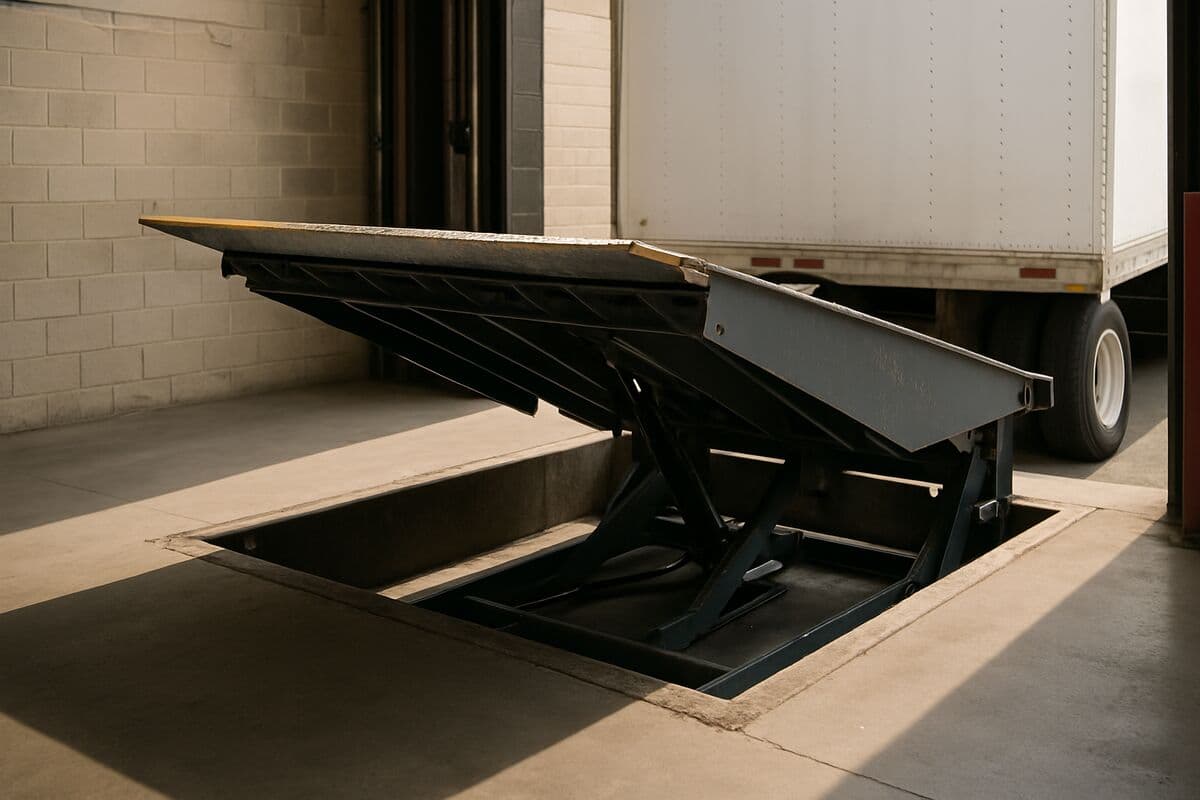
A planned maintenance visit is a hands-on inspection with the leveler raised, secured, and locked out. Blue Giant's manuals list the maintenance sequence as a safety visual inspection, cleaning including the pit area, visual inspection of all components, lubrication as required, test operating all functions, adjustments as required, checking for missing or damaged dock bumpers, and recording the inspection details and findings for the owner's files.
Rite-Hite's 90 day list for mechanical levelers gets more specific. It includes:
- Cleaning the pit area.
- Inspecting all lip out mechanisms (pins, lip crank, links, chains, and shackles) and replacing any that look worn.
- Lubricating the leveler with the proper lubricants in all appropriate locations.
- Inspecting weather seals, if installed, and replacing them if worn or damaged.
- Checking bumpers. Rite-Hite says four inches of bumper protection is required, and worn, torn, loose, or missing bumpers must be replaced.
- Checking the condition of the concrete, angles, and welds, and repairing as needed.
- Inspecting the structure, hinge pins, clevis pins, and cotter pins for abnormal wear and tear.
Rite-Hite's planned maintenance checklist also covers the lip spools, control box and pendant station, activation chain, switches and latches, rear hinge pins, toe guards, pit drain, wire harnesses, and the warning horn and lights, along with the bumpers and seals or shelters around the dock opening. Pentalift sums up a PM program as one that covers equipment inspection, lubrication, cleaning, and any adjustments that may be required.
This is not work for dock staff. Blue Giant's manuals state that all repairs and maintenance work are to be done by trained and authorized personnel only, that the maintenance strut and safety stand must be in place before maintenance begins, and that lubrication and adjustments are done by a trained service technician only.
Do Mechanical and Hydraulic Dock Levelers Need Different Maintenance?
The core schedule is the same, but powered levelers add components to check. If you are not sure which kind you have, our guide on what a dock leveler is and how each type works walks through mechanical, hydraulic, and air powered designs.
- Mechanical levelers. These rely on springs, chains, and a lip out linkage. Rite-Hite's 90 day tasks focus on those parts: the lip mechanism, pins, chains, shackles, hinges, and lubrication points.
- Hydraulic levelers. Rite-Hite suggests every daily and 90 day task, plus inspecting the hydraulic system (cylinders, hoses, fittings, and power units), checking the fluid level in the tank and adding fluid if necessary, and inspecting conduit boxes, control boxes, and electrical connections for damage.
- Air powered levelers. The same daily and 90 day tasks, plus an inspection of the air tower for damage and the same electrical checks.
- All powered levelers. Rite-Hite says to check the control box for any evidence of condensation, and every 360 days to check and tighten the control box mounting hardware.
Does OSHA Require Dock Leveler Inspections?
OSHA does not publish a dock leveler maintenance calendar, but its general industry rules do apply. Here is what the regulation text says, read directly from OSHA:
- Dock levelers are dockboards. 29 CFR 1910.21 defines a dockboard as a portable or fixed device that spans a gap or compensates for a difference in elevation between a loading platform and a transport vehicle, and says dockboards include dock levelers.
- Surfaces must be inspected and kept safe. 29 CFR 1910.22(d) requires walking-working surfaces to be inspected, regularly and as necessary, and maintained in a safe condition. Hazardous conditions must be corrected or repaired before employees use the surface again, or guarded until they are, and repairs involving structural integrity must be performed or supervised by a qualified person.
- Dockboard rules. 29 CFR 1910.26 requires dockboards to support the maximum intended load. Dockboards put into initial service on or after January 17, 2017 must be designed, constructed, and maintained to prevent transfer vehicles from running off the edge, unless the employer demonstrates there is no run-off hazard. Measures such as wheel chocks or sand shoes must keep the truck or trailer from moving while employees are on the dockboard, which is the job of the loading dock restraints checked in the daily list above.
- Lockout/tagout during service. 29 CFR 1910.147 covers servicing and maintenance of machines where unexpected energization, start up, or release of stored energy could cause injury. Blue Giant's manuals direct technicians to follow OSHA lockout/tagout procedures when working on electrical components of a powered leveler.
The industry standard for built-in levelers is ANSI MH30.1, published through MHI's Loading Dock Equipment Manufacturers group (LODEM). MHI lists the 2022 edition as ANSI MH30.1-2022, Design, Testing, and Utilization of Dock Leveling Devices, and describes it as a guide for designers, manufacturers, sellers, installers, owners, users, and governing bodies, including the responsibilities of each party. The standard is sold rather than published free, and we did not rely on its full text for this article. In practice, the interval comes from your leveler's manufacturer, and OSHA's "regularly and as necessary" language is the reason to follow it.
How Does Usage Change the Service Schedule?
Usage is the biggest variable. A leveler that cycles a few times a day ages differently from one that runs every hour across two or three shifts, which is why Blue Giant tightens its interval from three months to monthly for multi-shift operations and Pentalift ties PM frequency directly to usage.
Questions worth asking when you set your schedule:
- How many shifts does the dock run? Single shift docks fit the 90 day interval. Multi-shift and 24/7 docks should plan on monthly visits under Blue Giant's guidance.
- How heavy are the loads? Every leveler has a rated load classification on its serial plate. Blue Giant says operating outside it can void the warranty, and a dock that routinely runs near its rating deserves closer attention.
- How fast does debris build up? Dust, shrink wrap, broken pallet wood, and packaging all end up in the pit and hinge. Docks exposed to wind-blown dust, which is common around desert warehouses, may need more frequent cleaning between PM visits.
- Has anything changed? New tenants, new trailer types, or a jump in volume are all reasons to revisit the schedule.
What Are Signs a Dock Leveler Needs Service Now?
Do not wait for the next PM date if the leveler shows a problem. Blue Giant's manuals say dock equipment that is structurally damaged, experiencing performance irregularities, or potentially compromised should be removed from service until a trained and authorized representative can inspect and repair it. Common examples:
- The leveler will not raise, lowers slowly, or will not hold its position.
- The lip does not extend fully or does not rest securely on the trailer bed.
- The deck surface feels unstable or uneven.
- Worn, torn, loose, or missing bumpers.
- Cracked concrete or damaged curb angles at the edge of the pit.
- Visible damage to hydraulic cylinders, hoses, or fittings, or condensation inside the control box.
- Missing or unreadable safety labels.
If the leveler has to come out of service, block off the position so it is not used by mistake. OSHA's walking-working surface rule requires a hazard that cannot be fixed immediately to be guarded so employees cannot use the surface until it is repaired.
Why Keep Dock Leveler Maintenance Records?
Records protect both the equipment and the business. Blue Giant's manuals say written records of maintenance procedures should be kept as per warranty requirements, and that failure to properly maintain the leveler can void the manufacturer warranty. Pentalift recommends recording each leveler's model and serial number and keeping copies of all service work completed for each dock position.
A simple file per dock door works: the owner's manual, the serial plate information, the completed daily checklists, and every PM and repair report. When a question comes up after an incident or a warranty claim, that file is your answer.
Dock Leveler Maintenance in Las Vegas and Henderson
Hearth and Home Specialties works with warehouses, distribution centers, and commercial facilities across Las Vegas, Henderson, and Southern Nevada. Our technicians are trained to work on all makes and models of mechanical and hydraulic dock levelers. Our scheduled maintenance visits include a full inspection, lubrication, spring tension adjustment, and a written report of items needing attention. Learn more about our dock leveler repair and maintenance service.
To set up planned maintenance or request a repair, call (702) 474-4099 or submit a service request online. This guide is general information. Your leveler's manufacturer and the regulations that apply to your workplace have the final word on your maintenance schedule.
Dock Leveler Maintenance FAQs
How often should dock levelers be serviced?
Check the leveler every day before use, and have a trained technician perform planned maintenance at least every 90 days. Blue Giant recommends every three months for single shift docks and monthly for multi-shift docks. Your manual has the final word.
Does OSHA require dock leveler inspections?
OSHA counts dock levelers as dockboards. Its walking-working surface rule requires surfaces to be inspected regularly and as necessary and kept safe, but the rule text does not set a fixed number of days. Manufacturer schedules fill that gap.
What should the daily dock leveler check include?
Clear debris from the leveler and lip hinge, confirm the leveler operates normally, check bumpers, curb angles, and labels, and make sure a vehicle restraint or wheel chocks are present and working. Report anything that is not right before the dock is used.
What happens during dock leveler planned maintenance?
A trained technician cleans the pit, inspects the lip mechanism, hinges, pins, welds, and bumpers, lubricates where needed, tests every function, makes adjustments, and records the findings. Hydraulic and air units also get a check of the power unit, hoses, and controls.
Do hydraulic dock levelers need more maintenance than mechanical ones?
They need the same daily and 90 day tasks plus checks on the powered parts. Rite-Hite adds inspections of the hydraulic system, electrical connections, and control box, a fluid level check, and a 360 day check of control box mounting hardware.
Can skipping dock leveler maintenance affect the warranty?
It can. Blue Giant's owner's manuals say failure to properly maintain the leveler can void the manufacturer warranty, and that written maintenance records should be kept as per warranty requirements. Keep a copy of every service report for each dock position.
Sources
- Rite-Hite, How to Know When Your Loading Dock Levelers Need to Be Serviced
- Rite-Hite, Planned Maintenance of Your Dock Leveler Equipment (With Checklist)
- Blue Giant, Hydraulic Dock Leveler Owner's Manual (038-1084E, Rev. 1.7)
- Blue Giant, Mechanical Dock Leveler Owner's Manual (038-1083E, Rev. 1.6)
- Pentalift, Loading Dock Equipment Maintenance Recommendations
- OSHA, 29 CFR 1910.21, Scope and Definitions (Walking-Working Surfaces)
- OSHA, 29 CFR 1910.22, General Requirements (Walking-Working Surfaces)
- OSHA, 29 CFR 1910.26, Dockboards
- OSHA, 29 CFR 1910.147, The Control of Hazardous Energy (Lockout/Tagout)
- MHI Loading Dock Equipment Manufacturers (LODEM), Publications and ANSI MH30.1